You Name It: Sheet Metal Trainee Program

For Cargolux, maintaining the legendary 747 fleet requires more than spare parts — it takes skilled hands and sharp minds. As aviation evolves and structural repairs become a rare craft, Cargolux developed its own Sheet Metal Shop Training Program. Foreman Mark, Senior Technician Joshua, and Technician Erik, reveal how this in-house program safeguards vital expertise.

WHAT: Understanding the Sheet Metal Shop
The Sheet Metal Shop is where structure meets resilience. “We perform modifications and repairs on the structure of the aircraft as well as on components,” explains Mark. “From lightning strikes to cargo-loading damages, our team ensures aircraft integrity is restored.” Beyond replacements, technicians often adjust parts by hand, applying specialized treatments such as heat treatment, chemical conversion, or shot peening (cold working of parts).
It’s classic manual work. You need to think ahead, use your hands, and create solutions — not just replace parts. At the end of the day, you see what you’ve accomplished with your own hands — that’s what makes this job so satisfying
By 2017, the shop faced a challenge: structural repair skills were becoming a “dying trade.” Many MROs shifted focus to composite materials, while 747 spare parts grew scarce.
“We realized we had to pass on our knowledge,” Mark recalls. “Without a structured program, we risked losing essential expertise to keep the 747s flying.”


For Joshua, who trained under the old system, the difference is clear: “Before, our training was bits and pieces from manuals or other companies. There wasn’t a clear structure — sometimes you’d get conflicting instructions. Now it’s transparent, logical, and adapted to Cargolux’s reality.”
He recalls how disorienting it was to receive contradictory guidance: “One trainer would show you a method, then another would tell you it was wrong. As a young guy with a $60,000 part in your hands, it made you very uncertain. Today, we all speak with one voice — it gives trainees a solid base and the confidence they need to grow.”
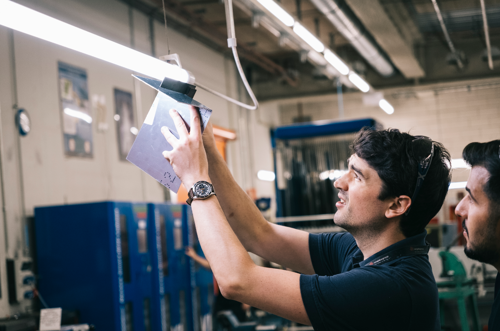
The training also prepares the team for the unexpected repairs Cargolux often faces first, due to the intensity of its operations. “Our aircraft fly so much more than passenger airlines,” Joshua explains. “What might take another carrier 15 years to wear down, we experience after 10 years. That means we’re often the first to encounter certain issues — sometimes even before a repair procedure exists. The training gives our people the mindset and skills to handle those situations.”
Joshua witnessed the difference first-hand, and during his 15-year career he’s seen the training evolve dramatically.

The new Cargolux in-house training program, launched in 2018, blends theory and hands-on practice over four months. It mainly focuses on the following four themes:
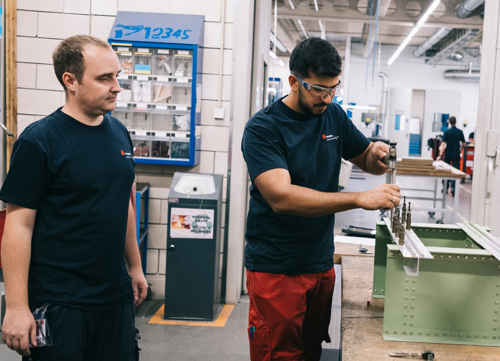
Teamwork is built into the training. “If one person rivets, the other holds the steel block behind. Communication and trust are everything,” says Erik. Mark agrees: “Often, you can’t even see your colleague — one is outside the fuselage, the other is inside. All you hear is his voice through the intercom. You must trust him completely. If he says ‘go ahead’ at the wrong moment, you could cause more damage than the initial defect. That’s why we train our people to use clear, standardized communication — and to rely on each other fully.”
The program also emphasizes honesty and accountability. “Quality is our number one priority,” Joshua explains. “If a trainee makes a mistake, we’d rather they tell us immediately. Integrity is vital in our work.”

IMPACT: Shaping Tomorrow’s Experts
The results are already visible not just that trainees finish the program with more confidence and readiness but repairs are performed faster and with fewer errors. Knowledge that was once scattered across veterans is now structured and transferable. Joshua has also noticed how much faster the new generation adapts compared to his own experience: “When I started, it sometimes took two years before I felt confident with certain repairs because we hadn’t covered them in training. Today’s trainees are ready much earlier — the program gives them a head start and saves everyone time.”
A crucial impact of the program is the preservation of rare skills. Many maintenance organizations have moved away from techniques like creating convex contours with the English wheel, or processing curved materials with the shrinker, or the stretcher. At Cargolux, however, these methods remain essential. "Sooner or later, we will have to remake parts ourselves,” Mark explains. “We’re only allowed to do that if we can meet the production standards of the original vendors. That’s why passing on these traditional processes is so important — it keeps the expertise alive for the next generation.”
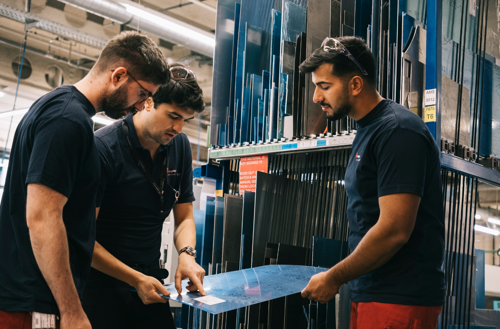
The program continues to grow. In November 2025, Cargolux welcomed five trainees — the largest class so far. Mark, Joshua, and Erik have updated modules, refined drawings, and expanded content.
“Finding young people ready to get their hands dirty isn’t easy,” Mark admits. “But those who join discover a job that’s creative, concrete, and deeply satisfying.”
It’s a philosophy he embraces himself: after years in engineering school, he chose Cargolux precisely to return to manual work. “That’s what keeps me here after 20 years,” he says.


Joshua underlines that the training is not just about technique but about shaping a mindset: “We want people who are curious and unafraid to take responsibility. The tools and methods can be taught, but the right attitude — precision, transparency, teamwork — that’s what makes a great sheet metal technician.”
“Sometimes it’s almost like being an artist,” Erik reflects. “You think, you shape, you create. That’s the spirit we want to pass on.”
Because at Cargolux, the Sheet Metal Shop is more than metal repair — it’s craftsmanship, team skill, and pride that will keep the 747s flying high for years to come.
Working at Cargolux